PDD Holdings: Assessing Potential and Risks in the Competitive E-Commerce Landscape
Understanding the Business Model
PDD Holdings is essentially a dual-pronged business, operating as one of China’s most prominent discount aggregate retailers. The business model has evolved from an agricultural focus to a broader e-commerce platform that directly connects consumers with manufacturers, thereby bypassing traditional middlemen. This creates a reliance on transaction fees and commissions for revenue.
The company further diversified its model with the global launch of Temu, which met with considerable success. In a strategic shift, PDD has now introduced Xinpinmu, a private label initiative that signifies a transition into self-operating e-commerce. The company plans to allocate approximately 115 billion yuan—roughly $17 billion—over the next three years to scale this venture, with a clear focus on bolstering supply chain capabilities.
The Question of Competitive Advantage
A critical component of my assessment is determining whether PDD possesses a “moat.” The late Charlie Munger, when evaluating Alibaba, characterized it as “just another goddamn retailer.” As long-term investors, we must ask how PDD can maintain profitability within such a highly volatile and intensely competitive e-commerce landscape.
The most objective measure of a company’s moat is its ability to consistently generate and grow cash flow.
Financial Overview and Margin Dynamics
Recent performance metrics for PDD reveal some noteworthy trends:
- Decelerating Growth: While PDD initially experienced triple-digit growth, this has decelerated to the 9-11% range.

- Margin Compression: There has been a discernible decline in margins. Although net income remains relatively robust at 22%, this figure includes interest income from the substantial cash reserves on the balance sheet.
- Cash and Liquidity: The company maintains a strong financial position, with approximately $77 billion in cash, short-term investments, and non-current assets, against $30 billion in liabilities. This indicates a significant equity/cash position of roughly $60 billion.

- Merchant Financing: PDD continues to benefit from a model where payments from customers are received immediately, while payments to merchants are deferred. This allows the company to operate using merchant capital, a tactic famously utilized by Amazon.
The Management Dilemma
The central issue facing PDD is whether the current margin compression is a result of essential, strategic investments in the supply chain that will ultimately widen its moat, or if these are merely necessary costs to maintain market share, thus depleting present and future profits.

Management has explicitly stated their commitment to prioritizing the long-term health of the platform over short-term financial performance. This strategy involves heavy investment in AI and supply chain infrastructure—an area where competitors like Alibaba and JD.com are also competing aggressively. The question remains: Who will emerge as the victor, and to what extent will investors benefit?
Investment Conclusion
From my perspective, PDD does not possess the kind of durable competitive advantage that would warrant a place in my core portfolio. Despite its financial stability, the intense competitive environment and the heavy emphasis on re-investing profits rather than returning value to shareholders through dividends or buybacks make this a complex investment case.
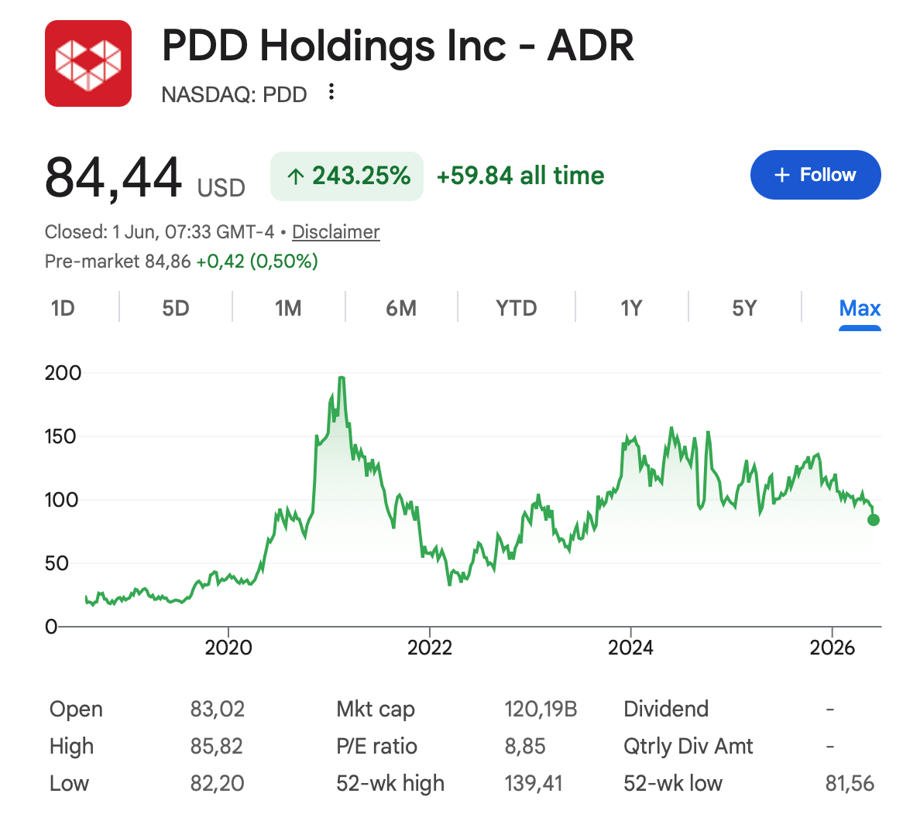
However, the valuation presents an interesting dynamic. With a market capitalization of $120 billion and $60 billion in cash and cash equivalents, the company is trading at a low P/E ratio on an adjusted cash basis. If the company continues its growth trajectory and the Xinpinmu initiative successfully establishes a third pillar of the business, the current valuation could prove to be an attractive bargain.

Currently, I categorize PDD as a “bet” rather than a core investment. I anticipate significant volatility, with the stock potentially experiencing dramatic fluctuations. For investors seeking a higher degree of certainty, a “wait and see” approach—observing how the company navigates increased investments and potential margin pressures over the coming quarters—may be the most prudent path.
Ultimately, PDD’s future performance rests on the success of its new initiatives and its ability to maintain growth in an increasingly crowded market. For now, the future of the stock remains uncertain, and its path forward is anything but clear.
For more in-depth analysis on this topic, watch the full discussion here: