Charter Communications: A Deep Dive into an Extreme Asymmetric Opportunity
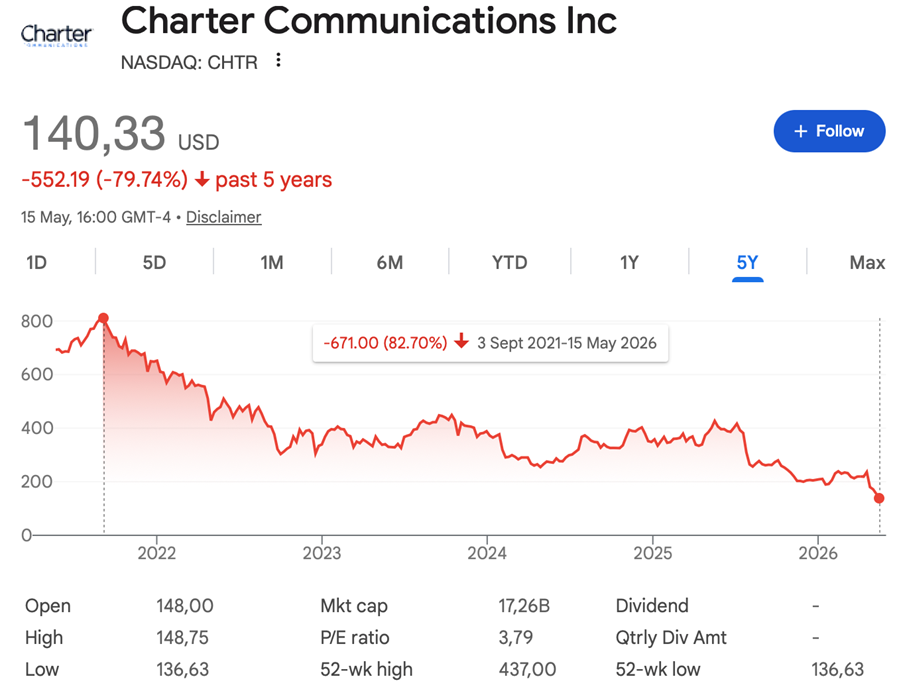
Charter Communications presents a complex, high-stakes scenario that I have been monitoring closely as the stock has pulled back from $230 to $140. To understand if this represents a rare opportunity or a value trap, we must break down the mechanics of their cash flow, the looming “wall of debt,” and the aggressive capital allocation strategy.
The Math Behind the 3x to 5x Potential
From a purely quantitative perspective, the numbers are striking. Charter currently generates about $5 billion in free cash flow (FCF) annually, which, when adjusted for the Cox acquisition, brings the base figure to approximately $6 billion.
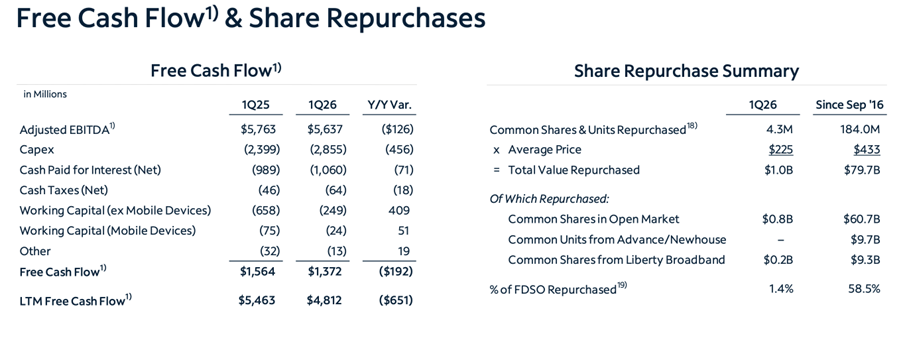
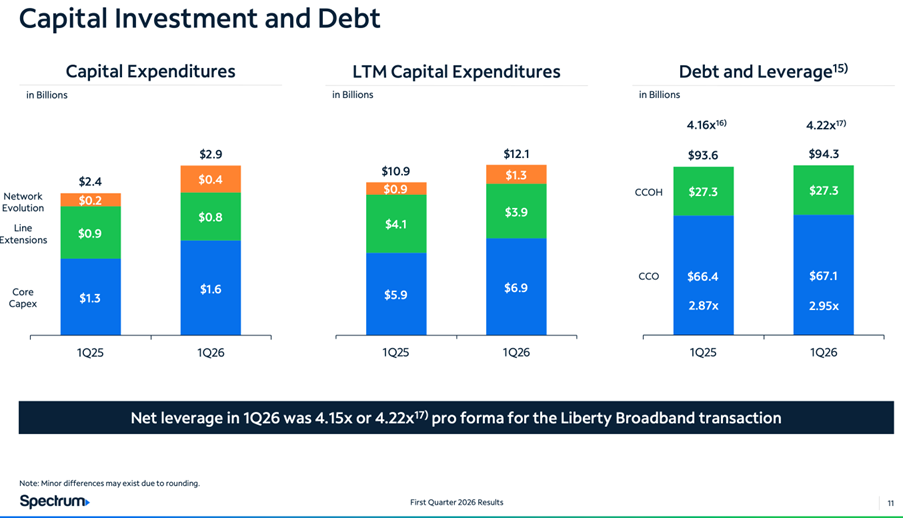
The critical factor for the next few years is the trajectory of capital expenditures. Currently, capex is heavy—roughly $12 billion—driven by network evolution, line extensions, and broadband upgrades. My expectation is that as these projects mature and capital intensity declines by 2028, Charter could see FCF expand to between $6 and $8 billion.
Against a post-merger market capitalization of roughly $27 billion, generating $8 billion in annual FCF is a massive proposition. If the company uses this cash to aggressively repurchase shares, they could theoretically retire a significant portion—if not all—of the outstanding equity within a few years. While the prospect of a “27 million-fold return” is a mathematical exercise in a scenario where no stock is left, the real-world potential for a 3x to 5x return is quite plausible if the business stabilizes and the market eventually applies a normalized P/E ratio of 12.
The Debt Wall and Operational Headwinds
However, we must be honest about the risks. The “wall of debt” is the primary threat to this thesis. Charter currently carries about $110 billion in debt, and as older notes mature, the company is forced to refinance at significantly higher interest rates—shifting from 4-5% to 7% or higher. This transition will inevitably push interest expenses from the current $5 billion level toward $6.5 billion annually, all else equal.
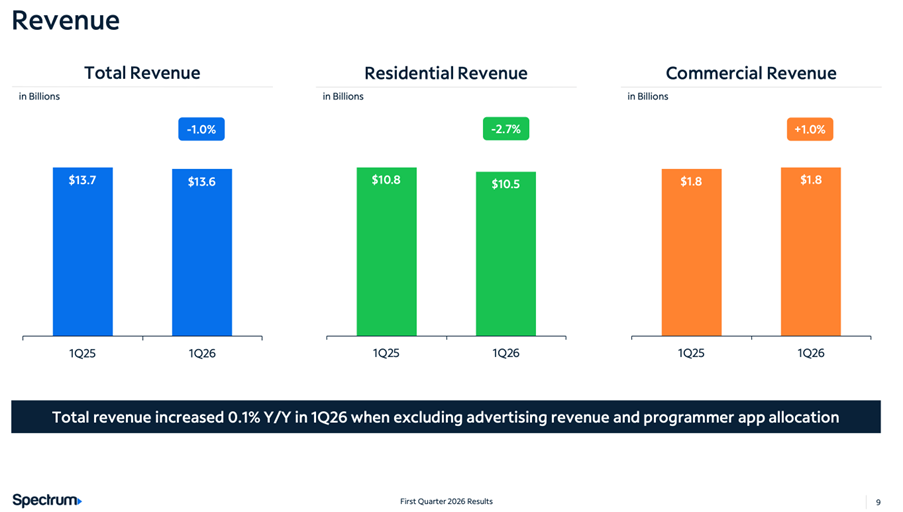
Operationally, the company is struggling with customer erosion, having lost 1.5% of its base over the last 12 months. While they have attempted to bundle services and leverage mobile lines to stem the tide, EBITDA is still showing signs of decline. Because Charter maintains some of the most competitive, low-price spectrum in the market, they are caught in a difficult spot: to grow revenue, they need higher customer volume, but they are currently relying on pricing power that is being tested by heavy competition.
Scenarios for the Future
To navigate this, I look at three distinct scenarios:
- The Bull Case: The company stabilizes customer numbers, capex drops as projected, and the $6–$8 billion in FCF is funneled into relentless buybacks. This would likely cause the stock to decouple from its current lows and move parabolically toward $500–$800.
- The Stagnation Case: If revenue and EBITDA continue to decline by 2-3% annually, the debt burden becomes increasingly oppressive. With a 5x EBITDA leverage covenant, a drop in EBITDA to $22 billion—down from the expected $28 billion—would significantly heighten the risk of financial distress.
- The Tail-Risk Case: In a scenario involving stagflation, higher interest rates, and no pricing power, FCF could collapse, potentially leading to a total loss of value if debt covenants are breached.
My Strategic Take
I classify Charter not as a traditional “value investment” with a wide margin of safety, but as a asymmetric bet. The risk of total failure is real, which is why I personally cannot include it in my core portfolios.
However, for those comfortable with the high-risk, high-reward nature of this trade, the strategy is to manage position sizing. I would suggest that if one were to take a position, it should be part of a diversified basket of such “bets”—perhaps 2% of a portfolio—where you accept that several might go to zero, provided that a few successfully realize that 5x return. It is essential to avoid the mistake of over-allocating, as I have seen investors do with positions as high as 22%, which is simply too dangerous given the downside potential.
Ultimately, whether this stock is a buy depends entirely on your personal risk tolerance and your belief in management’s ability to navigate the upcoming refinancing cycle.
For more in-depth analysis on this topic, watch the full discussion here: