The Value Investing Risk & Reward Quadrant by Sven Carlin
The core of value investing is taking advantage of market irrationalities by finding low risk and high reward investing opportunities. To put this value investing concept into a visual perspective I have developed the Value Investing Quadrant.

Value Investing Quadrant by Sven Carlin updated April 2025 (publicly analyzed stocks (discussion and links below), premium quadrant on Sven Carlin Stock Market Research Platform)
Risk & Reward
The two key components of the value investing quadrant are risk and reward. Despite mainstream finance stating how to get higher rewards, one must also endure higher risks (usually measured as volatility), value investing states the opposite: to maximize investing returns and allow for long-term compounding, one must first minimize risk. The minimization of risk will lead to the maximization of long-term rewards.
The low risk and high reward concept might be counterintuitive but let me use the S&P 500 index to demonstrate how it works. Over the past 30 years, the best time to buy the S&P 500 was in the February of 2009, given that was the lowest price offered for it by the market.
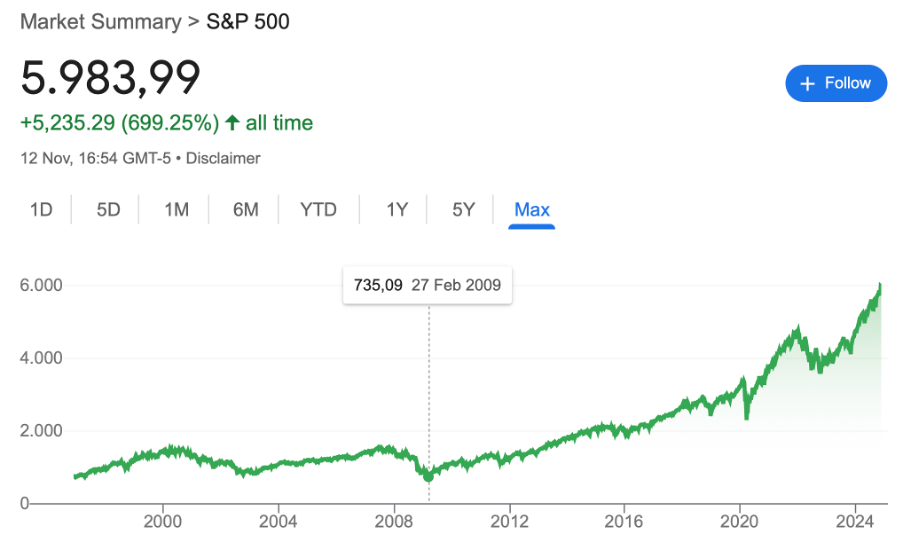
Academic or traditional risk measures had been stating it is extremely risky to buy the index at that point in time because of the high volatility after a 50% drop from 2007 to 2009. However, from a value investing perspective risk is not a function of volatility, risk is a function of price. Within value investing, risk is defined as the possibility of long-term permanent capital loss or the achievement of long-term unsatisfying investment returns.
Those buying the S&P 500 index in 2009 invested in a low risk and high reward asset. The 2007 S&P 500 earnings were 82.54 points and thus the PE ratio at the lowest point of the index of 666 points, using the 2007 earnings as future potential earnings, if we assume a reversion to normality at some point in time, was just 8.06. Is there long-term investing risk or the possibility of long-term loss if you buy the best global agglomeration of businesses at a PE ratio of 8? Unlikely.
But, on some occasions, the market is so pessimistic about an asset that it just wants to get rid of it at whatever price because it fears a continuation of the decline and increased losses. That is exactly where value investing comes in by looking at the fundamentals as we did above. It is key to have a fundamental perspective on the long-term value of the assets compared to the price asked by the market rather than believing that the price trend is of any indication of the value of the asset.
As the market will always be irrational, because we people make the market, and we as humans are all but rational beings, there will always be opportunities to take advantage of. The value investing quadrant is a tool that can help you take advantage of those opportunities.
The Value Investing Quadrant
I have put reward on the x axis going from low to high and risk on the y axis with high risk on the bottom and lower risk towards the top.
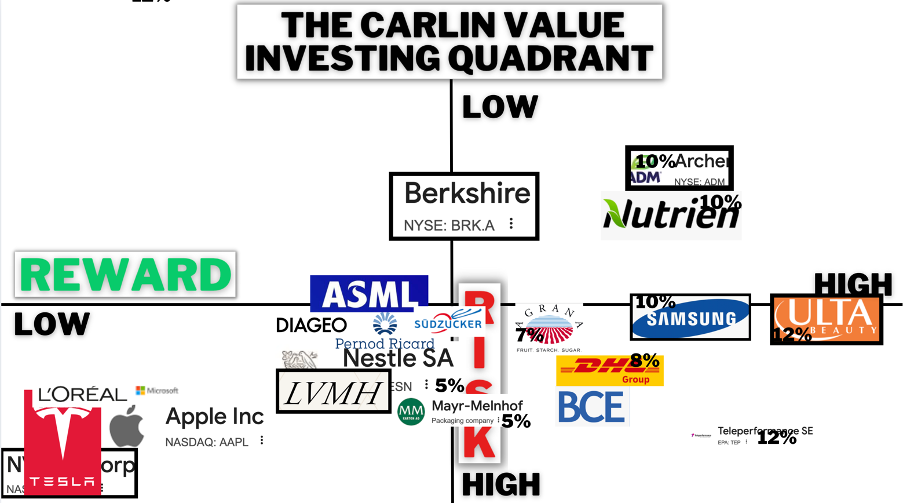
Value Investing Quadrant by Sven Carlin – November 2024 (publicly analyzed stocks (links below), premium quadrant on Sven Carlin Stock Market Research Platform)
To use the quadrant, we have to determine both the risk and the reward for a security.
The risk side of investing
As risk is not volatility but more of a subjective assessment of the negatives related to investing into a security, I like to think about risk in the terms of what can go wrong?
If I invest into a business, I can understand the risk related to investing in it by thinking about what can go wrong from a fundamental, long-term investing perspective. This includes considering the potential for permanent capital loss which is a situation where you are forced to book a loss on that investment. This can be a result of a bankruptcy, a loss of market position, a price paid that was too high, a change in the business environment, political issues like sanctions and many other situations that can impact an investment.
It is important to note here, the possibility of a temporary decline in a stock price should not be considered as risk. As we discussed above, the market is irrational, so it is impossible to predict stock prices in the short term. We are talking about business risks here and long-term stock price risks, especially if the price paid is too high.
For example, I consider Berkshire one of the strongest businesses in the world, a financial fortress and therefore the risk of permanent capital loss with Berkshire is practically non-existent over the long-term. Berkshire will keep compounding for the long-term because it is made to do so.
However, risk is also a function of price, and to understand that all we have to do is to look at Buffett’s buyback activity. When BRK’s stock was relatively cheap in 2020 and 2021, Buffett increased his buybacks but lowered those in 2022 and 2023 to almost eliminate them in 2024. The answer to that is simple, the price for BRK stock was too high and Buffett didn’t consider it a benefit anymore to do buybacks and preferred to hold treasuries offering a 5% yield.

BRK’s buybacks

Berkshire stock price
As I am writing this in November of 2024, I would say over the long-term, there is little risk of permanent capital loss with Bekrshire, but there is the risk of low or unsatisfactory investment returns as we discussed in the Berkshire stock valuation video. BRK will likely double its earnings again in the next 5 to 10 years, but if the PE ratio drops from the current 25 to 12 where 12 is closer to the historical average, investors will make no returns. Consequently, BRK stock is a low risk investment proposition for the long-term from a business perspective but it also brings the risk of low rewards over time due to its high current price.
The reward side of investing
When it comes to rewards, I like to think of the value that the business creates for me as an owner/investor. Warren Buffett uses to call this owner’s earnings and he looks at the increase in the book value over a year. From 2002 to 2023, Buffett increased the equity of Berkshire from $65 billion to $570 billion by compounding earnings year by year.
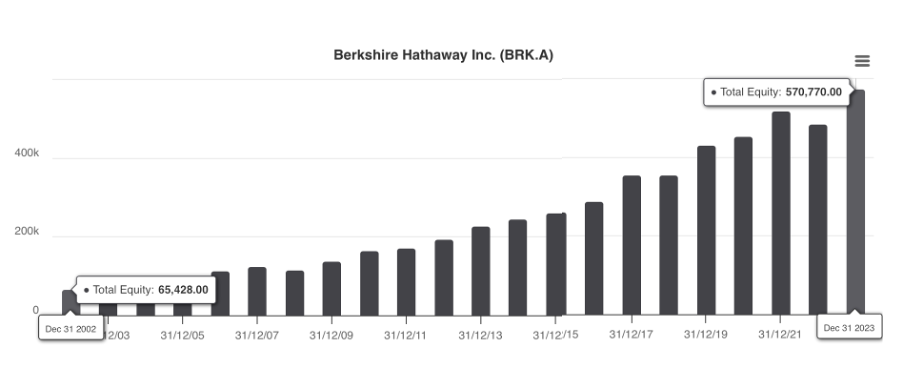
Berkshire’s equity from 2002 to 2023 Source: Tikr
The value created for Berkshire shareholders grew from $4 billion per year to the current $40 billion. Of course, there will be recessions, insurance disasters and investing mistakes, but when it comes to estimating the reward of the business, I like to use a conservatively estimated cyclical average. That average can be compared to the price and then one can wait for opportunities that will arise when the market turns pessimistic.
Value Investing Quadrant Conclusion and Updates
The value investing quadrant is a handy tool to constantly remind oneself about the core value investing principles as value investing is the most likely path towards long-term compounding. Only value investing works in whatever environment.
When investing, we have to strive to find investments that are low risk and high reward. By minimizing risk, we avoid big and costly mistakes and by comparing risk to reward, we can patiently wait for the right opportunities to come to us.
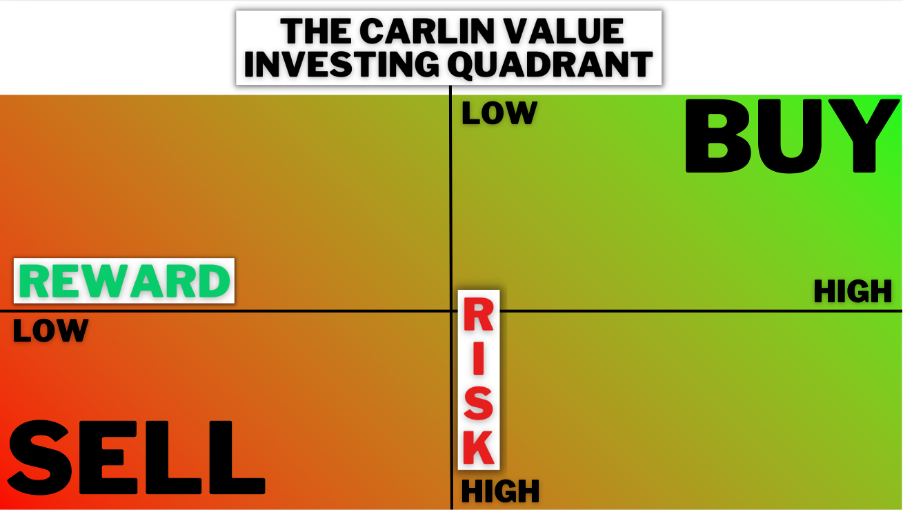
The value investing quadrant
I update the value investing quadrant once a month and if you wish to get the update into your inbox, subscribe to the value investing quadrant newsletter but I’ll also update on the value investing course.
If you enjoyed Value Investing, want to get monthly updates on the Value Investing Quadrant, join the value investing quadrant newsletter:
Links to stocks discussed and analyzed:
ULTA https://www.youtube.com/watch?v=bVAVTIjtapI
ADM https://www.youtube.com/watch?v=_30SLDQzJ-E
NUTRIEN https://www.youtube.com/watch?v=yup8cFOITXE
SAMSUNG https://www.youtube.com/watch?v=zI70-4i02cY
TELEPERFORMANCE https://www.youtube.com/watch?v=XjozyeenlFQ
DHL https://www.youtube.com/watch?v=87fEIE3MAww
BCE https://www.youtube.com/watch?v=_cBuKmaeo9s
AGRANA https://www.youtube.com/watch?v=ThsmWmrpsAk
BERKSHIRE https://www.youtube.com/watch?v=fu1-3P7UPyM
AUSTRIA https://www.youtube.com/watch?v=izFV3cZS4SU
ASML https://www.youtube.com/watch?v=rmR3pgy4SU0
PERNOD https://www.youtube.com/watch?v=Lr0gvEKxNM8
NESTLE https://www.youtube.com/watch?v=gvDD-m3wRUQ
DIAGEO https://www.youtube.com/watch?v=Lr0gvEKxNM8
APPLE https://www.youtube.com/watch?v=evu6ipzMWkk
L’OREAL https://www.youtube.com/watch?v=v0q9xaUre_w
TESLA https://www.youtube.com/watch?v=_XAH6C8PW8cNVIDIA https://www.youtube.com/watch?v=GtDT5R4LWVQ