Interactive Brokers: A Strong Broker and Stock, but What’s Next After a 31% Decline?
Interactive Brokers (IBKR) has long been regarded as one of the most innovative and cost-effective brokerage platforms in the financial services industry. Known for its global market access, low trading fees, and advanced technology, the company has attracted a diverse client base, ranging from individual investors to institutional players. However, despite its strong business fundamentals, Interactive Brokers’ stock has experienced a significant decline of 31% from its recent highs. This article provides a detailed analysis of the company’s business model, the factors driving its stock performance, and whether it remains a compelling investment opportunity. Check Interactive Brokers for Yourself.
If you want to learn more about the business in detail, check out the full video on Interactive Brokers.
Interactive Brokers: A Global Brokerage Powerhouse
Interactive Brokers operates as a leading electronic brokerage firm, offering clients access to over 135 markets across 33 countries. The company’s platform is renowned for its low-cost structure, robust trading tools, and comprehensive research capabilities. With a strong presence in the Asia-Pacific region, Interactive Brokers has positioned itself as a key player in one of the world’s fastest-growing markets.
Key Strengths of the Business
- Global Market Access: Interactive Brokers provides clients with the ability to trade stocks, options, futures, forex, and cryptocurrencies across multiple geographies. This global reach is a significant differentiator, particularly for investors seeking diversification beyond their domestic markets.
- Low-Cost Structure: The company’s competitive pricing model has been a major driver of its growth. By leveraging automation and technology, Interactive Brokers has been able to offer some of the lowest trading fees in the industry, attracting cost-conscious investors.
- Interest Income: A substantial portion of Interactive Brokers’ revenue comes from net interest income. The company earns interest by investing client cash balances and pays out a portion of this income to clients. With rising interest rates over the past year, this revenue stream has grown significantly.
- Scalability: Interactive Brokers’ automated systems allow it to scale efficiently as its client base grows. This scalability has enabled the company to maintain high profitability margins even as it expands its operations.

Financial Performance: A Year in Review
Over the past year, Interactive Brokers has delivered strong financial results, reflecting the resilience of its business model. Key highlights include:
- Client Accounts: The number of client accounts grew by 30%, reaching a record high. This growth underscores the company’s ability to attract and retain customers in a competitive market.
- Revenue Growth: Commission revenue increased by 37%, driven by higher trading activity and increased client engagement.
- Net Income: Net income rose by 11%, supported by higher interest income and improved operational efficiency.
- Earnings Per Share (EPS): The company reported an EPS of $7 for the year, up from previous levels, reflecting its strong profitability.
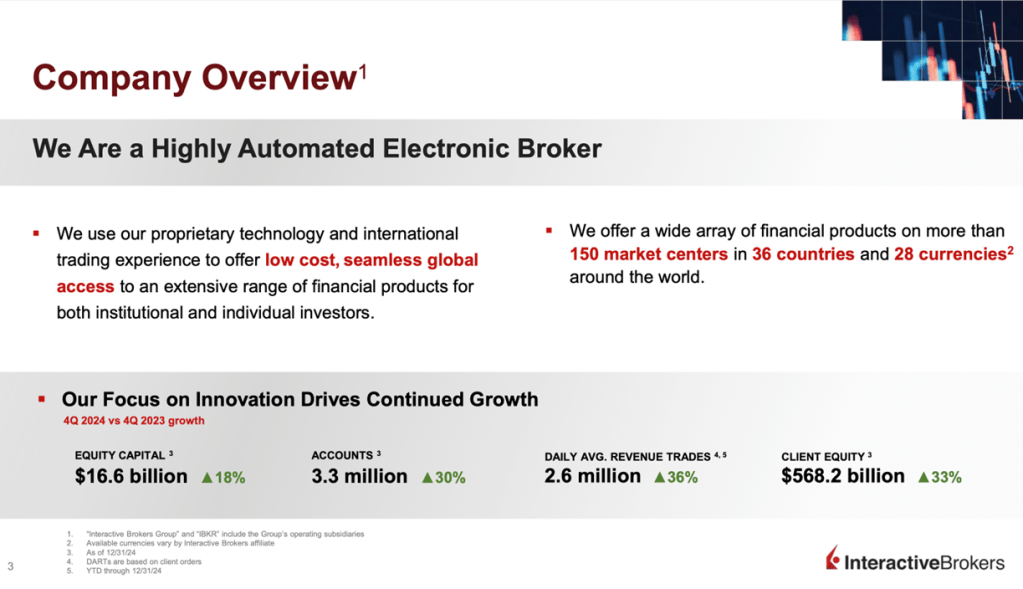
Despite these positive metrics, the stock’s performance has been underwhelming, with shares declining by 31% from their peak. This disconnect between business performance and stock price raises important questions about the factors driving the sell-off.
Understanding the Stock’s Decline
The decline in Interactive Brokers’ stock price can be attributed to several key factors:
- Interest Rate Sensitivity:
- Interactive Brokers generates a significant portion of its revenue from net interest income. As interest rates rose, the company benefited from higher spreads between the interest it earned on client cash balances and the interest it paid out. However, with the Federal Reserve signaling potential rate cuts in response to easing inflation, this revenue stream is expected to shrink. For every 25-basis-point decrease in the Fed funds rate, the company anticipates a $64 million reduction in annual net interest income. This sensitivity to interest rate changes has weighed heavily on investor sentiment.
- Market Volatility and Trading Activity:
- While Interactive Brokers has benefited from increased trading activity during periods of market volatility, there are concerns that this trend may not be sustainable. A potential economic slowdown or recession could lead to reduced trading volumes, particularly in speculative assets like cryptocurrencies. Additionally, lower stock prices and weaker market performance could further dampen investor enthusiasm.
- Valuation Concerns:
- At its peak, Interactive Brokers’ stock was trading at elevated valuations, fueled by the AI-driven trading boom and a surge in retail investing. As market conditions normalized, the stock retreated to more reasonable levels. However, with a forward P/E ratio still in the mid-30s, some investors remain cautious, especially if earnings growth slows.

Valuation and Investment Considerations
The recent decline in Interactive Brokers’ stock price has created a more attractive entry point for long-term investors. However, the stock’s near-term performance will likely depend on the trajectory of interest rates and broader market conditions.
- Current Valuation: At its current price, the stock trades at a forward P/E ratio in the mid-30s. While this is lower than its peak valuation, it remains relatively high compared to historical levels. If earnings decline from $7 to $5 per share due to lower interest income and reduced trading activity, the stock’s valuation could remain under pressure.
- Margin of Safety: For investors seeking a margin of safety, waiting for the stock to approach the $100 level may be prudent. At that price, the stock would offer a more compelling risk-reward profile, especially if earnings rebound to $9 per share in the future.
- Dividend and Shareholder Returns: Interactive Brokers’ dividend policy and commitment to shareholder returns add to its appeal as a core holding in a diversified portfolio.
Conclusion: Is Interactive Brokers a Buy?
Interactive Brokers remains a best-in-class brokerage platform with a strong track record of growth and innovation. While the stock’s recent decline reflects legitimate concerns about interest rate sensitivity and market volatility, the company’s long-term prospects remain intact. For investors with a long-term horizon, the current pullback could present an attractive buying opportunity, particularly if the stock approaches lower levels.

Value Investing Risk & Reward Quadrant (check all the stock analyses)
When investing, your capital is at risk. The link in this description to Interactive Brokers is an affiliate link. This means I may earn a commission if you click them, at no cost to you. These links help support me and the channel, but they are not part of any sponsorship. I am only sharing my own experience and the views I express are mine alone – I’m not a financial advisor and do not make investment recommendations or give investment advice. You should always do your own research and due diligence before investing. None of the information contained herein constitutes a recommendation, offer, promotion, or solicitation of an offer to buy, sell or hold any security, financial product or instrument or to engage in any specific investment activity.
I often get asked about brokers, here is a low fee broker, an international one that allows you to buy on global markets, and also offers complex solutions like options for when your investing skills grow. For now, it is one of the best solutions I have found for global investors, also based on your comments and inputs: