HP Inc. (HPQ) and Hewlett Packard Enterprise (HPE): A Comprehensive Analysis of Challenges, Opportunities, and Investment Prospects
In the ever-evolving technology sector, Hewlett Packard Enterprise (HPE) and HP Inc. (HPQ) have long been stalwarts, but recent market dynamics have raised questions about their future prospects. Both companies are grappling with cyclical pressures, competitive challenges, and significant investments in emerging technologies like artificial intelligence (AI). This article provides a comprehensive analysis of HPE and HPQ, examining their financial performance, strategic initiatives, and the risks and opportunities they face. By the end, investors will have a clearer understanding of whether these stocks are undervalued opportunities or best approached with caution.
If you want to learn more about both businesses in a detailed video, check it out here:
Hewlett Packard Enterprise (HPE): High Risks Amid AI Ambitions
Hewlett Packard Enterprise, which focuses on enterprise solutions, cloud computing, and AI, has faced significant challenges that have weighed on its stock price. Let’s delve into the factors impacting HPE’s performance and valuation.
Financial Performance
- Revenue and Margins: HPE’s gross margins have declined by approximately 6% due to aggressive pricing strategies and competitive pressures. The company is investing heavily in AI and cloud infrastructure, but the returns on these investments are uncertain.
- Free Cash Flow: HPE expects to generate $1 billion in free cash flow by 2025. While this is a positive sign, it translates to a free cash flow yield of around 5% based on the current market capitalization of $20 billion. This is significantly lower than the yield implied by its P/E ratio of 7, suggesting that the stock may not be as cheap as it appears.
Strategic Challenges
- Uniper Acquisition: HPE’s proposed $14 billion all-cash acquisition of Uniper has raised concerns among investors. The deal, which is under scrutiny by the Department of Justice, would increase HPE’s debt load and interest expenses. Given the uncertain margins in the AI and cloud sectors, the acquisition adds significant risk to the company’s financial profile.
- AI Investments: While HPE is positioning itself as a player in the AI space, the competitive landscape is crowded, and pricing pressures are intense. The long-term profitability of AI-related investments remains unclear, creating uncertainty for investors.

Debt and Financial Risks
HPE’s debt levels are a concern, particularly in a rising interest rate environment. The company’s ability to service its debt and maintain financial flexibility will be critical to its long-term success.
Investment Outlook
HPE’s low P/E ratio of 7 may seem attractive at first glance, but a closer examination reveals significant risks. The company’s declining margins, high debt levels, and uncertain returns on AI investments make it a challenging stock to value. For investors, HPE falls into the “too hard” pile, as it is difficult to predict how the business will perform in the next two to three years. While there is potential for significant upside if AI investments pay off, the downside risks are equally substantial.

HP Inc. (HPQ): A Cyclical Business with Strong Cash Flows
HP Inc., a global leader in personal computing and printing, has built a reputation for delivering reliable products and generating consistent cash flows. However, the company operates in a highly cyclical industry, where demand for its products is closely tied to economic conditions. Let’s explore the key aspects of HPQ’s business and its current investment profile.
Financial Performance
- Revenue and Earnings: HPQ has maintained stable revenue and earnings, supported by its strong market position in personal computing and printing. The company’s ability to generate consistent cash flows has been a key driver of shareholder returns.
- Free Cash Flow: HPQ is expected to generate $3 billion in free cash flow this year, with projections for even higher cash flows in the future. This translates to a free cash flow yield of 12-14%, which is attractive relative to its market capitalization.
- Dividend and Shareholder Returns: HPQ offers a dividend yield of approximately 4%, making it an appealing option for income-focused investors. The company has also been active in share buybacks, returning significant capital to shareholders.
Market Positioning
- Cyclical Nature: The personal computing and printing markets are highly sensitive to economic cycles. During downturns, businesses and consumers often delay purchasing new equipment, leading to margin compression and reduced revenues.
- Inventory Concerns: One area of concern is the rising inventory levels, which have increased from 12-13% of sales to nearly 16%. In a cyclical industry, excess inventory can lead to write-downs if demand weakens, posing a risk to profitability.
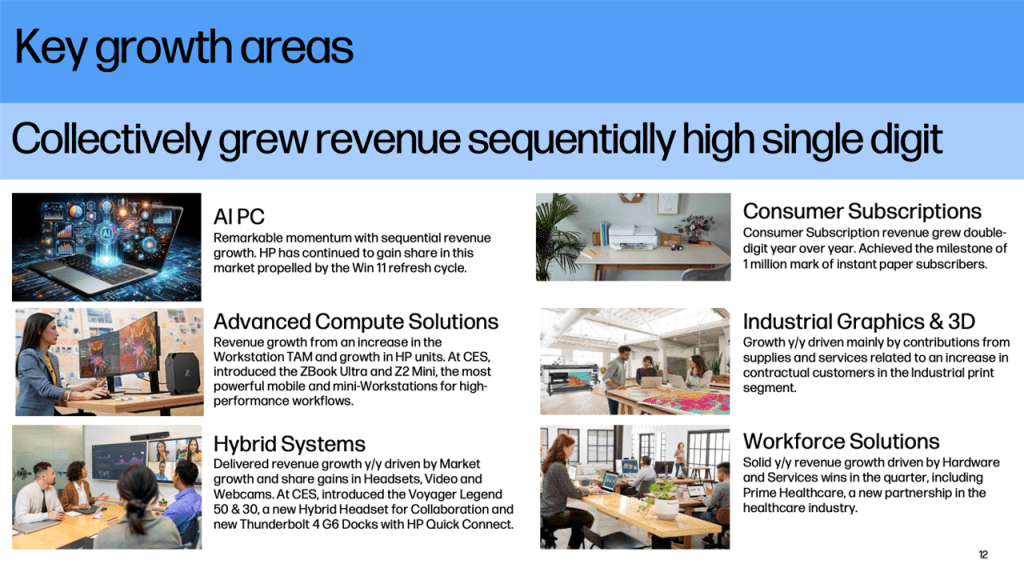
- AI Investments: HPQ is investing in AI-driven systems and solutions, but the returns on these investments remain uncertain. The competitive landscape in AI is intense, and margins are volatile, making it difficult to predict long-term profitability.
Debt and Interest Expenses
HPQ carries $10 billion in gross debt, which could become a burden as interest rates remain elevated. Higher interest expenses could pressure cash flows and limit the company’s ability to return capital to shareholders.

Investment Outlook
While HPQ’s strong cash flows and shareholder-friendly policies are appealing, the cyclical nature of its business and rising inventory levels present significant risks. For value investors, the stock may be more attractive during periods of economic weakness, when the downside is already priced in. At current levels, HPQ appears to be in the mid-cycle phase, with potential for further downside if demand weakens.
Comparative Analysis: HPE vs. HPQ
Both HPE and HPQ operate in competitive and cyclical industries, but their risk profiles differ:
- HPE: Presents higher growth potential through AI and cloud investments but carries significant financial and operational risks.
- HPQ: Offers stable cash flows and attractive shareholder returns but is vulnerable to economic cycles and inventory risks.
For value investors, HPQ may be the more appealing option due to its strong cash flow generation and dividend yield. However, the stock is best approached with caution, given its cyclical exposure. HPE, on the other hand, is a higher-risk, higher-reward play that may appeal to investors with a higher tolerance for uncertainty.
Conclusion: Proceed with Caution
Both Hewlett Packard Enterprise and HP Inc. face significant challenges in a rapidly changing technology landscape. While HPE’s ambitious AI and cloud investments offer growth potential, the associated risks make it a challenging stock to value. HPQ, with its strong cash flows and shareholder returns, is a relatively safer bet, but its cyclical nature and inventory risks cannot be ignored.
For investors, the key takeaway is to focus on businesses with predictable cash flows and clear margins of safety. In the case of HPE and HPQ, the current environment suggests that both stocks are best approached with caution.

Value Investing Risk & Reward Quadrant (check all the stock analyses)