High-Yield Dividend Chemical Stocks: Are Dow, BASF, and LyondellBasell Worth the Risk?
Check out the full video on YouTube, if you prefer reading however, keep scrolling.
The chemical industry has long been a cornerstone of global manufacturing, providing essential materials for everything from packaging to automotive production. However, recent economic challenges have weighed heavily on the sector, leading to significant declines in stock prices for major players like Dow Inc. (NYSE: DOW), BASF SE (OTC: BASFY), and LyondellBasell Industries (NYSE: LYB). Despite these challenges, these companies now offer attractive dividend yields of around 7%, making them potential candidates for income-focused investors. But are these high yields sustainable, and do these stocks present a compelling risk-reward opportunity? Let’s dive into the details.
The Current State of the Chemical Industry
The chemical sector is highly cyclical, with performance closely tied to global economic conditions. In recent years, the industry has faced headwinds such as slowing demand in key markets like China and Europe, overcapacity in certain product categories, and rising input costs. These challenges have led to declining revenues and margins for many companies, including Dow, BASF, and LyondellBasell.
Despite these difficulties, the sector remains essential to the global economy, and long-term growth prospects—though modest—are still present. The global chemical market is expected to grow at a compound annual growth rate (CAGR) of 1.46%, driven by demand in packaging, consumer goods, and emerging markets. However, this growth is far from stellar, and companies must navigate a challenging environment to maintain profitability and shareholder returns.
Dow Inc.: Stability Amid Challenges

Dow Inc., one of the largest chemical companies in the world, has seen its stock price decline significantly in recent years. However, the company remains profitable, with a focus on cost-saving measures and shareholder returns. Dow has committed to returning $2.5 billion annually to shareholders through dividends and buybacks, representing a 9% shareholder yield based on its current market capitalization.
Key Highlights:
- Dividend Yield: 7%
- Shareholder Returns: $2.5 billion annually (dividends and buybacks)
- Challenges: Weak demand in Europe and China, overcapacity in key product categories like polyethylene
- Outlook: Management expects stability in free cash flow, supporting the current dividend. However, a significant upturn in the cycle would be required to drive substantial earnings growth.
Risks:
- Commodity Exposure: Dow’s profitability is heavily dependent on commodity prices, which are subject to significant volatility.
- Economic Sensitivity: Prolonged weakness in global manufacturing and construction could further pressure revenues and margins.
BASF: Navigating a Tough European Market
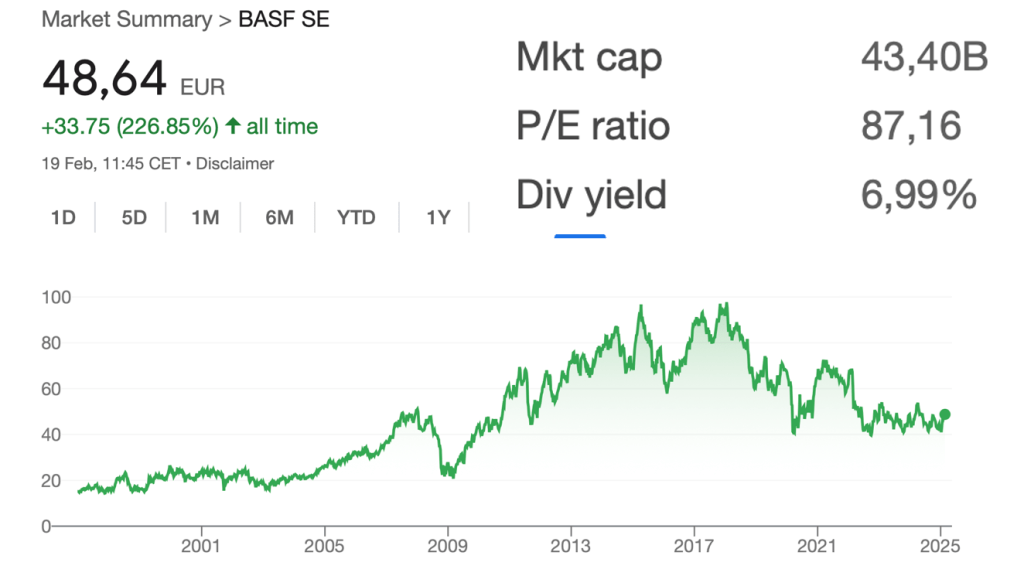
BASF, a German chemical giant, faces additional challenges due to its heavy exposure to the European market, which is experiencing a manufacturing slowdown and higher energy costs. The company has outlined a strategic plan to improve profitability, including cost-cutting measures and investments in growth markets like China.
Key Highlights:
- Dividend Yield: 7%
- Strategic Focus: Building a new production site in China (Zhangyang Verbund) to capitalize on Asian growth
- Financial Targets: Aiming for €7-9 billion in EBITDA by 2028, assuming mid-to-upcycle conditions
- Challenges: Weak demand in Europe, high operating costs, and overcapacity in key product categories
Risks:
- European Exposure: BASF’s reliance on the European market makes it vulnerable to regional economic weakness.
- Execution Risk: The success of its strategic initiatives, particularly in China, is critical to achieving its financial targets.
LyondellBasell: Balancing Dividends and Growth

LyondellBasell, a global leader in polyolefins and petrochemicals, has also seen its stock price decline amid industry headwinds. The company has maintained a strong commitment to shareholder returns, with $1.9 billion allocated to dividends and buybacks in 2023.
Key Highlights:
- Dividend Yield: 7%
- Shareholder Returns: $1.9 billion annually (dividends and buybacks)
- Challenges: Overcapacity in the polyethylene industry, sluggish demand for durable goods
- Outlook: Management expects a recovery in global demand, but timing remains uncertain.
Risks:
- Commodity Price Volatility: Like Dow, LyondellBasell’s profitability is tied to commodity prices, which can fluctuate significantly.
- Competitive Pressures: The company faces intense competition from low-cost producers in Asia and the Middle East.
Risk-Reward Analysis
While Dow, BASF, and LyondellBasell offer attractive dividend yields and the potential for significant capital appreciation in an industry upturn, they also come with substantial risks. Key considerations for investors include:
- Cyclicality: The chemical industry is highly cyclical, and these companies are price-takers with limited pricing power. A global economic downturn could lead to further declines in revenues and margins, potentially forcing dividend cuts.
- Competitive Pressures: Overcapacity in key product categories and competition from low-cost producers could limit profitability.
- Execution Risk: Each company’s ability to execute its strategic initiatives—whether cost-cutting, divestitures, or investments in growth markets—will be critical to its long-term success.

Value Investing Risk & Reward Quadrant (check all the stock analyses)
Conclusion: Are These Stocks Worth the Risk?
For income-focused investors, Dow, BASF, and LyondellBasell offer compelling dividend yields and the potential for capital appreciation in an industry recovery. However, these stocks are best suited for those with a high risk tolerance and a long-term investment horizon. The lack of competitive advantages and reliance on commodity prices make them vulnerable to economic downturns and industry headwinds.
If you’re considering adding these stocks to your portfolio, it’s essential to:
- Start Small: Begin with a modest position to limit exposure to potential downside risks.
- Monitor Closely: Keep an eye on industry trends, company performance, and macroeconomic conditions.
- Be Prepared to Average Down: If the sector experiences further declines, consider adding to your position at lower prices to enhance long-term returns.
Ultimately, while these high-yield chemical stocks may not be suitable for everyone, they could be a valuable addition to a diversified portfolio for investors willing to navigate the risks.
Why have chemical industry stocks declined recently?
The chemical industry is an industry without a proper competitive advantage, thus all are price takers. In such an environment, the good years of 2021 and 2022, flushed the companies with money, all went on investing and which led to the current overcapacity and lower margins. As the saying in cyclical sector goes:
“low prices lead to high prices, high prices lead to low prices”
What are the risks of investing in chemical stocks?
The risks are always related to a recession that would severely impact chemical businesses as margins decline, many production sites would be put on care and maintenance and stock prices would look very ugly.
Should I buy chemical stocks now?
Chemical stocks look fairly priced at the moment in a mid-cycle situation with an average, over the cycle, free cash flow yield of around 10%. This means there is medium risk and medium reward. Chemical stocks are a strong buy when the average cycle free cash flow yield is around 20% and the price to book value is below 0.75.
How can I manage risk when investing in chemical stocks?
Managing risk has to be related to portfolio exposure, if you want to own chemical stocks, you can start with a minor exposure, let’s say 5%. If things go well, you get 7% dividend and a 2x in the stock price over the cycle from the current position. If things head towards a recession, you can double down easily and then make 4x on the upturn.