Berkshire Hathaway (BRK) Is Not a Buy at Current Levels
You can watch the full video discussing BRK stock here:
For decades, Berkshire Hathaway has stood as the gold standard of disciplined capital allocation. Under Warren Buffett’s leadership, the company has compounded shareholder wealth by acquiring high-quality businesses, maintaining a fortress balance sheet, and prudently reinvesting retained earnings.
However, despite these undeniable strengths, investors should be cautious about buying Berkshire at today’s valuations. While the company remains stable and well-managed, the outlook for prospective returns is limited.
Strong Earnings, but Weak Prospective Returns
Berkshire reported approximately $34 billion in earnings over the past 12 months, excluding the noise of accounting gains and losses tied to market fluctuations in its investment portfolio. These results reflect the true earnings power of Berkshire’s operating businesses — from insurance to railroads to energy.
Yet, when stacked against its current market capitalization of around $1 trillion, those earnings imply a yield of only about 3–4%. Even factoring in reinvestment and long-term growth of 3–6% annually, expected returns are capped in the 5–7% range.
This is far from disastrous, but it is underwhelming for new investors seeking to outperform the broader market.
Buffett’s Silence Speaks Volumes
One of the most telling indicators about Berkshire’s valuation comes directly from Warren Buffett’s actions. Historically, Buffett has authorized aggressive share repurchases when he believed Berkshire stock offered at least an 8–10% return potential.
Today, buybacks have slowed significantly. The company has executed only modest repurchases, a stark contrast to periods when the stock traded at far cheaper levels. Instead, Berkshire is holding over $340 billion in cash, primarily invested in short-term U.S. Treasuries that now yield about 3.5–4%.
This positioning should be viewed as a clear message: Buffett sees few compelling opportunities, either in Berkshire’s stock or in the broader market. If Buffett — the ultimate long-term value buyer — is sitting on the sidelines, that should raise caution flags for investors.
The Challenge of Size
Berkshire’s scale has become both a blessing and a burden. With hundreds of billions in cash reserves, the company has the financial firepower to weather downturns, acquire businesses, and support its subsidiaries. But that same size limits Berkshire’s flexibility.
Smaller, nimble companies can deploy capital into high-growth opportunities with outsized returns. Berkshire, by contrast, must target acquisitions and investments large enough to move the needle. Those opportunities are increasingly rare — particularly in an environment where asset prices remain elevated.
This size constraint suggests that Berkshire’s future returns will converge closer to the overall growth of the U.S. economy, rather than significantly outpacing it.
Intrinsic Value Estimates Highlight Limited Upside
Using a discounted cash flow approach, and assuming 6% annual earnings growth with a terminal multiple of 15, Berkshire’s projected 2034 earnings imply a market capitalization of about $1 trillion. Discounted back to present value at a 10% required rate of return, that equates to roughly $390 billion in intrinsic value — far below today’s trillion-dollar market cap.
Even under more optimistic assumptions — higher growth rates, higher terminal multiples, and fewer economic shocks — the return profile remains capped in the mid-single digits.
On the downside, if growth slows or the economy enters a prolonged downturn, Berkshire’s stock could experience a 30–70% drawdown, in line with historical market cycles.
The Buffett Succession Factor
While Buffett’s eventual departure is inevitable, this is not the primary risk for Berkshire. The company has institutionalized a culture of discipline, conservatism, and long-term focus. Greg Abel, the designated successor, is expected to continue this approach.
The real challenge lies in the combination of Berkshire’s size and valuation. The company is too large to pursue smaller, higher-return opportunities, and too expensive to offer an attractive margin of safety at current levels.
The Verdict: A Safe Compounder, But Not a Buy
There is no denying Berkshire Hathaway’s resilience and quality. It will continue to be a long-term compounding machine, and investors who already hold the stock can remain confident in its stability. Over decades, Berkshire will likely outperform many alternatives and continue to preserve wealth.
But for new investors considering entry today, the stock simply does not present an attractive risk-reward trade-off. With muted return expectations, Buffett’s reluctance to buy, and the structural limits imposed by size, Berkshire is not a compelling buy at current prices.
Bottom Line
- Earnings yield is too low relative to market capitalization.
- Buffett isn’t buying — and that signal matters.
- Scale limits flexibility, capping long-term growth potential.
- Intrinsic value estimates suggest limited upside.
Berkshire is an outstanding company, but outstanding companies are not always outstanding investments. At today’s levels, patience and discipline may serve investors better than chasing Berkshire at a trillion-dollar valuation.
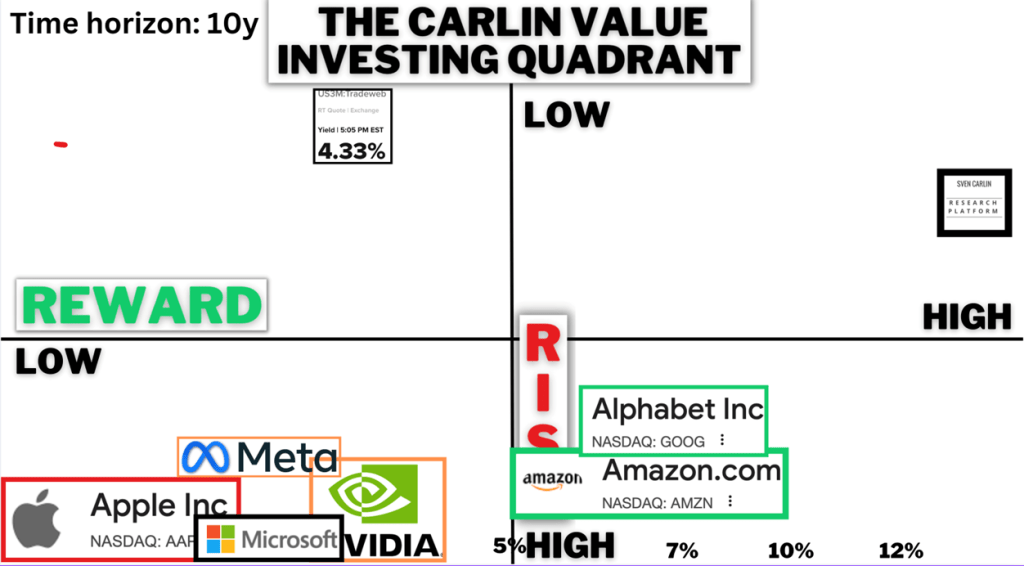
Value Investing Risk & Reward Quadrant (check all the stock analyses)